
How big will my Dane be? Anubis is now 198 lb and Nifi is 178 lb
First let me say that those who down-play the size factor forget that a "great" size is a major characteristic of the GREAT Dane. Without the great size, he just isn't GREAT!
I hate skinny or small Danes. Our Dane has a massive 50 inches chest size.
Several American and European Danes are too small, and as a result, the Dane's head too is proportionally small and the dog just doesn't have the graceful Dane image, in fact at times it doesn't even look like a Dane!
The argument that size isn't everything is silly. Yes, he must have other qualities, but these qualities are in addition to size, not a substitute.
The Dane's title, the gentle giant, means that he must have both features, the good characteristics and the giant size.
The height of the Dane is measured in inches at the shoulder; at the highest point in contact with the start of the neck "withers", see illustration below. A large Dane is about 3 feet at the shoulder, plus a foot of neck length and near another foot of head height which makes him almost 5 feet tall at the top of the head, and if he is standing on his back legs jumping on you with his front paws of your shoulders, he would about 6 or 6+ feet high.
The official standard height which is required in order for a Dane to qualify for showing and to get official certification is: 30 inches (at the shoulder) for a male and 28 inches for a female. We believe this is too small. Sure there are Danes 26 inches only, I have seem some of them and they are sold as "imports" as if they are a different breed of Danes .. Those are simply sub-standard and an excuse for a Dane. There are many small Danes with pointed smaller head sold as expensive imported line. There is only one standard of Dane conformation; and those sub-standard are just poor Danes.
There are very healthy large Dane lines like ours. Yes, some Large Danes have health problems. Someone was telling me about a breeder known to have hips and heart problems .. well, those Danes should not be bred! But again, there are small size Danes under 27" who also have the same health problems.
Now ... there are large good looking GREAT Great Danes in the 34-35" and 36" category who are perfectly healthy and lead a wonderful long life. Shoulder height isn't a problem.
... So back to what a Dane size should be. it should be GREAT! Great & Healthy!
Weight should be more of a concern at some point because it can be associated with fat buildup.
Keep in mind too that some Danes have a small rib cage, others are big with heavy muscles.
The chart below will show you the acceptable (good) range of the large Dane's weight
and height expected of a good line of the gentle giant:
Age. Weight in Lbs Height in inches at the shoulders
At birth 2
week-1 3-5
3-5
3-5week-2 6-9
6-9week-3 10-16
10-16Month-1 17-22
week-6 25-30
25-30Month-235-40 17-19
35-40 17-19Month-340-55 20-23
40-55 20-23Month-455-70 22-26
55-70 22-26Month-575-95 24-29
75-95 24-29Month-6100-110 28-31
100-110 28-31Month-7115-120 31-32
115-120 31-32Month-8125-125 32-33
125-125 32-33Month-9125-130 33-34
125-130 33-34Month-10 135-145 33-35
Year-1 150-170 33-37
150-170 33-37Year-2 "adult male" 180-200 34-38
34-38Year-2 "adult female" 145-190 33-36
145-190 33-36Many Danes are smaller, considerably below the chart's size and weight. We don't vote for them.
Most Large Danes are in the 35-36" range at the shoulders. Some large Danes (ours included) make the 37" and very very few make the 38 inches shoulder height. The difference of one inch or so between 35-37 M or 33-35 F is insignificant but the difference between 29 and 32 F or 31 and 34 Male is considerable.
The following table will compare how a healthy-attractive or within the norm height of a human ("H" in ft/inch) would compare to a Dane ("D" in inches), considering the table of human height that states that:
5.7 is average/normal 5.8 is good 5.9 to 5.10 is average/healthy tall
5.11 to 6 is TALL in social perception (taller than average national tall and is within the healthy & attractive target)
6.1. to 6.2 is very tall and still within the healthy & socially attractive range
6.3 to 6.4 is unusual (attractiveness decreases at this point)
6.5 to 6.6 is abnormal and rare
and: 6.6 to 6.9+ is very rare/ too tall for ideal healthy blood circulation and is considered unexpected and undesired genetic glitch.
Based on the above, I came up with what I called it the Dane VS Human height chart, quoted by and referred to as the
Gouda Dane height table by the Great Danes magazine. Here is my illustrative - comparative chart:
Dane height Human total height
in inches = in F/I at the top
= in F/I at the topat the shoulders of the head
D30 meaning a Dane resembles: H 5.6 meaning a human
30 inches tall at 5 ft & 7 inches tall
5 ft & 7 inches tall the shoulder
D31 H 5.7
H 5.7D32 H 5.8 healthy - good
H 5.8 healthy - goodD33 H 5.9
H 5.9 very good D34 H 5.10
H 5.10 D35 H 5.11
H 5.11 Tall
D36 H 6.0
H 6.0 D37 H 6.1 Very tall
H 6.1 Very tallD38 H 6.4 abnormal, leaning
H 6.4 abnormal, leaning towards undesired appearance.
D39 undesired too long H 6.7 abnormal genetic glitch
H 6.7 abnormal genetic glitch goat-appearance legs. No registered breeder at the time of typing this, has such a too tall Dane. .The extremely rare genetic glitch of 39" is very rare and to my knowledge no breeder has a Dane at the that height alive except for the famous one that
made the world record, and as I indicated, the extra 3 inches height are in his legs and made his legs appear like goats legs, not an attractive feature.
Again, officially, a certified, qualified champion Dane can be 30" Male or 28" Female. We don't think this is "great" enough. We think that the minimum
should be 34M / 32F and the ideal - (in order to be "great" in size) should be 33-37M and 32-35F.
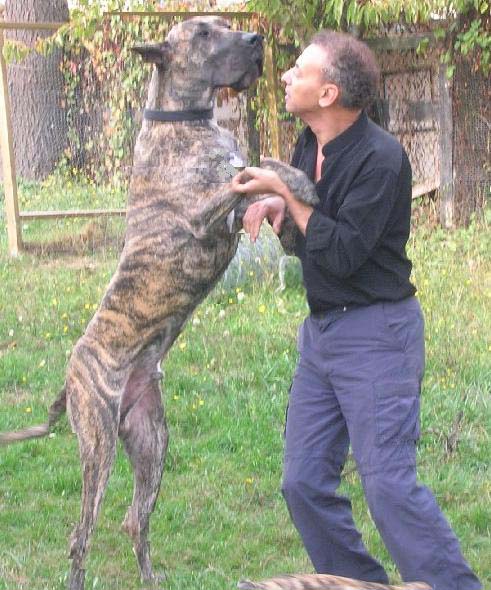
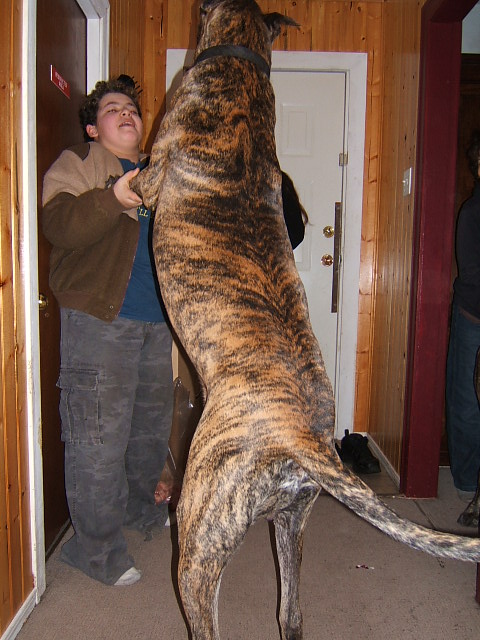
Note that the two pictures above show Anubis standing up against my son Pele and I. Of course he would be over 6 or 7 feet height. This is not how you measure a Dane; I say it because you'll hear someone say I saw a Dane that was "thaaaaat" tall!
Even when holding a Dane by the collar walking him, with 3 feet height at the shoulder, a foot or so neck and another foot or so the head & ears height, he would look like 4 to 5 feet high without standing up and you'll hear about a 5 ft tall walking Dane . Still, this is not how a Dane is measured, nor he is measure by how high he reaches standing on his back legs. If it was, Anubis would be 6 or 7 ft tall.
Below is how a Dane is measured.
As explained above, remember again that the officially acceptable height of a Dane to even enter a championship competition is 28" at shoulder for a female and 30 inches if a male. Many Danes are below that standard. Most professionally bred Danes are between 32 to 34 inches at the shoulders and that's a good size. Very few are 35-36" and that is a large Dane. Very rarely you will find a 37-38" Dane (I know of only two other Danes in North America that made that extra inch or two - and as I said, the inch or two difference at this stage (that rarely and unexpectedly may appear in a pup), is insignificant.
You need to be careful as many Danes are under-size and they just don't have the graceful Dane appearance. Many American breeders produce Danes as small as 28" and most - from what I have seen - are in the 29-31". That's perhaps why sometime you hear exaggerated perceptions when that person runs into a real Dane. I heard someone refer to our Anubis as a 6 ft tall Dane!
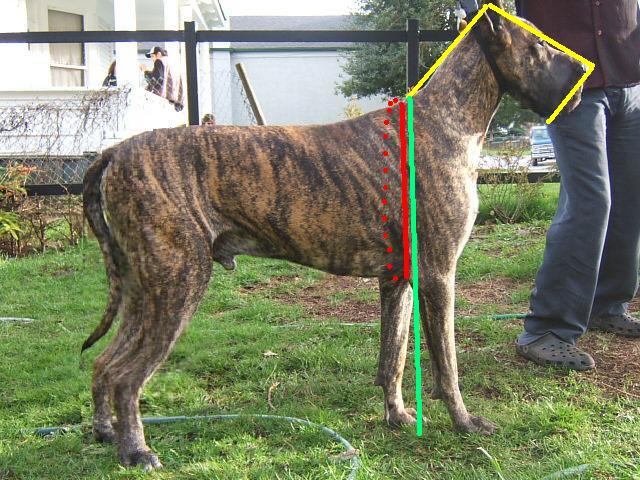
Below is how a Dane is measured. Not the at the top of the head (highest red line). Not including the neck (the second red line). The Dane is measured at the tallest shoulder point where the neck starts (the first red line extended in yellow colour). To measure your Dane, let him stand straight up against a wall in a show position, and with his head pulled up high, use a pencil to mark a dot or a line against the wall at the highest shoulder point at the start of the neck.
The chart above gives you a healthy and ideal expectation of the good range of a GREAT Great Dane.

Anubis & Cleo
greeting a friend
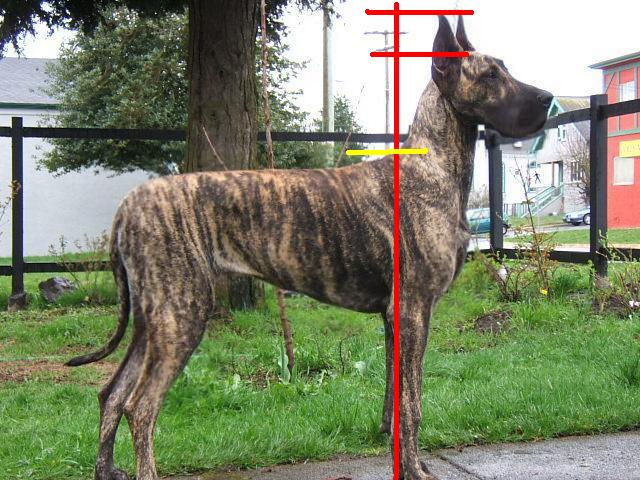
Nifi at age 14 months. 34" tall at the shoulder and is now 184 lb and 35.5".
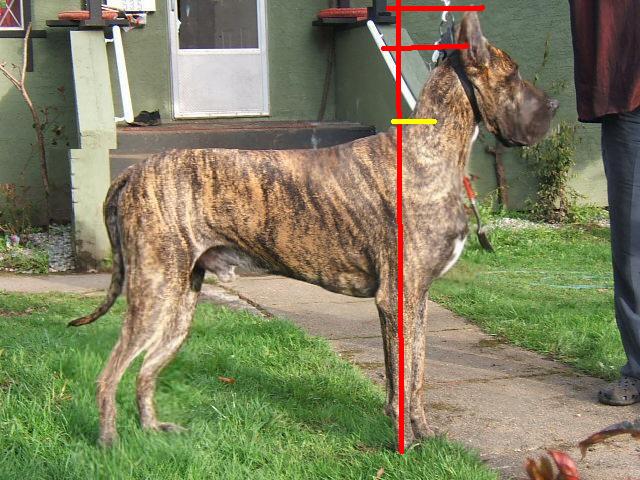
Anubis at age 19 months, 36" at the shoulder and is now
208 lbs and 37.5 inches. Note his impressive 50 inch chest "rib cage" size and his head which are persistent with his line.
As I indicated on the page
I have produced a measurement approach to present a representative method that gives a complete picture of the Dane's physical composition.
The picture to the right is showing our Dane's 3 measurements
The green line is the traditional height.
The red line is the circumference of the rib cage, the chest size
The yellow lines represent the length of the neck, head and lips area.
In this case, our Dane measures 37-50-33
meaning 37 inches tall at the shoulders (green line).
50 inches chest size, measuring around as shown in red.
33 inches of neck and head measurements (yellow lines).
Size
matters,
and, bigger is better.
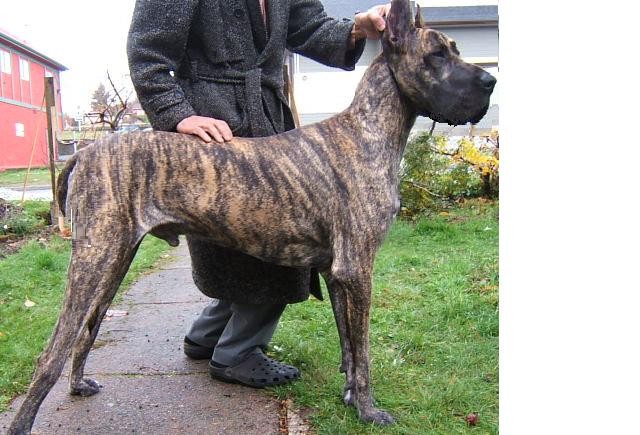
He is a 9 months pup in this photo.
He is now 191 lb with 50 inches chest size.
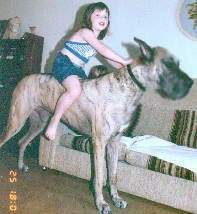

Columbo, in Aurora, Ontario
back in the 90s. Notice how high the 5 years girl's feet are from the floor. Kids used to back-ride him like a horse aroud the neighbourhood.
Anubis too allows it and enjoys it.
