We have a special diet programme for the mother prior to and during pregnancy scientifically proven to eliminate certain health risks known to appear in large dogs in nature. In fact, I have submitted a paper to EVURC and it has received a very positive response to the point of asking me to commercially make these formulas available to breeders. I have offered consultation to several breeders.
It's an expensive diet but it works. It always has. We never had a single problem with our Danes or pups. They all enjoyed a long healthy life and have passes health tests at adult age. That's why I confidently offer the longest health guarantee any breeder offers anywhere.
All I want is your assurance of a good home for the Dane.
Also I want to state a fact. These explanations and chat is a reflection of pride in and love for our Danes, not to convince someone that we have good Danes! This, again, is not a commercial operation. Danes are a hobby, a recreation and a family extension. Now, here are the facts:
1- Both parents have passed all health checks with flying coloursAT ADULT AGE, NOT AS PUPS under age two. Both parents had their hearts, shoulders, thyroid, hips, ears, elbows, teeth &
eyes checked and were reported very healthy. And:
2- Our pups are dewormed before they leave us. Although we never has a worm problem, we don't take a chance. We don't just give them the heart worm medication, we give them a complete
medication to deal with any tape worms, roundworms, hookworms and whipworms. They are vaccinated when examined at age 10+ weeks (a booster is a must after 3-4 weeks).
3- Both parents come from champion bloodline. If you look at for example Cleopatra's pedigree, you'll find something like 20 champion dogs (CBQ: Certified
Breeding Quality) in about 4 generations. This means that those champions, their parents and grand parents, went through a qualification process that involved careful exams - both medical and by judges in order to qualify for show points and the champion "CH" or "CBQ" (Certified Breeding Quality) title. If they had any visible problem such as eyes, teeth, bone structure, body conformation .. etc they would not have been approved by judges. And if they had any heart, hips or other problem that can be detected by blood test, x-ray or ultra sound they would not have obtained their breeding qualification.
4- Our pups have all been Vet-examined at age 8 weeks and documented healthy before leaving for their new homes. You'll have this fact determined and confirmed by your own vet. .
This involves examination of eyes, teeth, hips & bone structure, shoulders, heart & lungs. And the pups that were sold as show-breeding pups to breeders have all passed their additional required medical tests. If fact, at the age of just one year they have already obtained most of their show points; not only that, they also made "best in show" & "best in breed" and are scheduled to obtain their champion title at such young age.
So if the puppies, the parents, and the breeding care and background line are all healthy, does it mean that absolutely and definitely I shall never have a health problem with the pup?
Yes. The pup's chances are now much much better to have a long healthy life and are practically guaranteed to be 100% a secured long healthy life if the parents and the pup have been assisted with the right supplementary diets. Again, provided that the special care pre and during pregnancy and during the pup's first 8+ weeks is done right by the breeder. Continuing to administer the supplementary help as instructed by us, is strongly advised and definitely makes a huge difference. It is now your part of the job. One person who purchased a pup, as soon as he got him home at age 8 weeks, he sent me a picture of the pup hanging onto his shoulder - while the man is cooking, both hands busy, no protection or support. What if that pup fell from 5 feet high on a hard floor?
Otherwise, as far as the problems you hear about, the odds are in your favour by far. As I said, I NEVER had a problem and no test has ever show any potential problem.
We know of a healthy family with athletic and longevity background, one of their healthy-born children in a few years developed what can be described as an unexplained and unexpected genetic glitch that was never experienced by the parents or grandparents.
Another healthy couple we know, are exceptionally fit and yet their 22 years old has just been diagnosed with cancer! These are rare exceptions. And these rare exception becomes much more likely without the indicated proper pregnancy related care. Actually having said that, the chemical preservatives in our food and in dogs commercial food can cause cancer, and I'll address that in another page and will show you how to correct the problem.
There are different categories of health problems:
1-inherited genetic defect: if the parent or the background has a genetic problem, most likely the offspring will. Someone told me about a breeder whose Danes are known to live for about 4 or 5 years and often developed a heart problem. The Sire has a heart problem and died at 5 years old. He should have never been bred. If the parent or grandparent has a problem such as the heart, the chances are very high that the pup will have it. Such dog must never be bred.
2- a genetic glitch that may unexpectedly appear. I explained how we see it even in us humans. This is the rare exception, and with advanced supplementary diet it can be corrected. It is usually a result of genes, due to causes such as improper diet, suddenly malfunctioned, Genes and cells don't always function perfectly the way they are supposed to without our help. All our dogs and their parents and grand parents had no problem ... they all had healthy heart, eyes, teeth, bones ... no problem, none! To date, all our pups have been reported by their happy homes to be healthy Danes. All test papers including the less significant OFA qualification tests are posted here. The main factor here is the supplementary diet.
And, there is a 3rd case:
3- a) Genetic negative development influenced by physical factors including inherited problems,
b) a problem resulted by not compensating the Dane with his dietary needs during and after pregnancy.
c) a problem caused by an injury due to accident or gradual excessive physical activities..
a) Some genes can be triggered to mal-function by negative influence such as severe exposure to viruses or even emotional/psychological factors. Meaning, if the dog is not well taken care of in
terms of physical care both medical and general, and emotional and health care. This part is the new home's responsibility.
And again, we never had such a problem either. All our pups have gone to good caring homes and all our pups were reported happy & healthy.
b) See the page addressing this topic. This is very important and without it any healthy parents will still produce health problems.
c) A real case example comes to mind. A friend in Ontario breeding Mastiffs with exceptional health line. His dogs, their parents & grandparents never had a shoulder or hips problem. One of the
pups had a shoulder problem. The vet told the owner of the pup that you should contact the breeder because it could be a hereditary factor.
The causes of shoulder & hip problems are several - including possible hereditary; but also, even a healthy line, no hereditary factor, the healthy dog (rarely) can develop such
problem (especially in large breeds) as a result of other factors including:
i) wrong diet: excessive specific mineral such as calcium or imbalanced diet.
ii) lack of sufficient care during the pregnancy and the pup's early fetus formation stage as explained above.
iii) severe physical activities that could irritate a shoulder or a joint. Apparently, the young (but almost as heavy as a Dane) Mastiff I mentioned was routinely made to play by jumping high
to catch a toy and land with all his weight on his front paws several times a day even after he was limping with an apparent shoulder injury.
Of course the vet has to tell the owner that there are several possibilities; diet, wrong physical activities in an excessive manner that may cause an injury accident, or hereditary. The vet doesn't know whether the parents had this problem and as such he couldn't eliminate the hereditary possibility.
Well, we can tell you right now, our dogs have no health problems and our pups didn't thus far. As well, our pups have the ideal - and costly - pregnancy and 8 weeks diet.
Such sad stories by irresponsible breeders of puppy mills give the common person every reason to worry.
It is not true that large breeds have a lower chance of a long healthy life. Every Dane I had, enjoyed a very log healthy life. And at the same time, several friends and neighbours who have small dogs had many health problems including several who had toy dogs that didn't live half the average life span of the Dane. My Dane diet paper has proved to the HEVRI research institute that the right supportive diet plays the main role, including at the foundation stage during pregnancy and the pup's first 8 weeks.
So, for your peace of mind let me say that our record of long-lived healthy lines, certified healthy champions and healthy pups; and with your love & care for your dog and our initial care - especially the pre and during pregnancy health care, if you are blessed with one of our pups, you have every reason to expect your Dane to live a healthy long and happy life.
Finally, this is written to convince you that there are GREAT Great Danes, if the breeder does the job properly and spends the money it takes during pregnancy and during the pup's first 8 weeks. These comments were not written as sales talk at all. Again, we breed on average once a year and we select the homes out of several applicants, so please take these notes seriously and regardless of which breeder you approach, make sure they did the job right and will support it with a solid health guarantee.
Breeders who hide behind the so called OFA registered are playing games.
OFA test at such young age can be meaningless, and though its a "no-harm to do" approach, and I even finally considered it myself - just for for the sake of a good home that may not understand, yet, it is really not the answer. The answer is:
1- Danes with vet certificates of health clearance at age of approximately 4 years
and up.
2- The educated breeding diet and breeding approach explained.Please read the
page addressing the OFA test data registry via the link to the right.
3- Continued educated diet as instructed by this site via the writer, Dr. Paul Gouda.
One last note, your breeder, yours truly, is the author of the famous paper "corrective diet in Danes" - a research analytical chemistry based paper. Hope this will get you to listen more intensively.
Warm regards;
Paul.
To shed some light on this issue, here are two actual emails I received and I obtained permission to enter them here even without removing names. ?They show an example of poor breeding that produces poor health that had to be inherited.
Mr. Gouda,
I want to first thank you for your noble contribution to the Great Dane lines of the world. I have never seen such high quality Danes in my entire life.
I have owned Great Danes for the past 5 years and am an advent lover of the breed they are member of our family and reside indoors. I have worked with many Dane rescues to help my beloved breed find there forever homes. For 6 years I worked as a veterinary technician and have extensive knowledge of all animals but especially Great Danes. I have come across so many Danes that are very poorly bred. My first Dane who I named "Pharaoh" was the love of my life I got him at 6 weeks and was unaware of his congenital heart defect. By 1 year old I had him on Digoxin, Lasix, and Enacard. I was doing everything in my power to save my love. I worked closely with my Veterinarian to save Pharaoh. Yet it was to no avail because at almost 2 years old his heart could not compensate and he passed away.
Ever since I have been on a mission to obtain my own high quality Danes so that I may avoid the heart break that I still carry with the loss of Pharaoh. I wish to one day show Danes if I ever owned an amazing one or two. I love Egyptian names and was pondering Egyptian names for my future Great Dane. I currently have one Dane named "Egypt" and was considering the name "Cairo" when I thought of "Anubis". I typed it into google and there the most amazing Danes I have ever seen in this world stared back at me.
I live in Hawaii currently, I am a 26 year old nursing student, and my husband is a Marine in the US Marine Corps currently deployed to Iraq. We are stationed here in Hawaii until I graduate in August 2010 where then we will be moving to Virginia. I am hopelessly devoted to this breed and wonder if I may be blessed with the honor of perhaps being on your waiting list and one day being apart of your "good home list". At the very least know that you have a friend in Hawaii if you ever want to vacation here and one day and if I am so blessed and honored as to own a Dane or two from your litter it will be the happiest day of my life!
Aloha and God Bless from the state of lousy bred Danes...but beautiful beaches,
Samantha Isberner
6575 Kekahuna Pl APT B
Kailua, HI 96734
Hi Paul;
Hu is doing great. We attached photos. He was turning heads last month at the show and made best in breed then best in show. One of the judges said later she heard about your Danes twice and finally checked out your site and was extremely impressed. Most important, Hu went through bones, head and teeth X-rays, heart ultra sound and blood tests .. wow .. more tests than I ever had myself, and they all spelled excellent health.
We are most grateful we had a Dane from you and we plan another pup from you next year - we hope you'' approve us again.
We are grateful because 2 people we met had Danes that turned out nothing like Hu and Anubis - and, they also had so many health problems.We now know how hard it is to find a good and healthy Dane line.
We wish you all the best with your Danes.
Stan & De
Calgary, Alberta.
4-
This is another example of the difference between puppy mills with low breeding cost and a proper breeding.
In nature, large breeds sometimes develop shoulder and hips problems starting at age 1 or 2 years. This is not the type of unavoidable problem caused by unescapable inherited genes; it's a developed (introduced) potential health condition that only appears later if certain nutrients are not available at the early pup formation stage and are not enhanced later. And because we addressed this issue, we NEVER experienced such concern.
In other words, it is not a genetic confirmation that cannot be escaped, it's a genetic potential that can be avoided.
With proper and specific diet prior to and during pregnancy, this potential is eliminated as the developed fetus is given that extra special nutrients that are often missing in nature. This is a fact and our breeding records proves it.
Yes, this potential problem can be 100% corrected with proper care of THE MOTHER prior to and during pregnancy. A careful experienced diet including glucosamine, chondroitin, folic acid, methyl sufonyl methane (or msm), several specific B vitamins such as riboflavine, chlorthydate, cyanoncobalamine as well as several other vitamins and minerals in a very specific ratio - given a month prior to pregnancy and throughout pregnancy totally eliminates such potential danger.
Again I emphasize the importance of ratio and the danger of over dose. I would be glad to advise breeders on this issue.
For example calcium though essential, if not balanced with other specific elements can cause joint problems in large breeds and often shoulder and hip problems as early as age 16 months - and some even vets may assume its genetic i.e. the line, while in fact it's a developed not an inherited problem.
The short answer is: expect a long healthy life not just because we have a healthy line, but also becuase of our special health development programme. Not only I never had a single problem, I dare to offer, in writing, a life time 10 years guarantee. The secret is in the breeding and the understanding of Dane's supplementary needs.
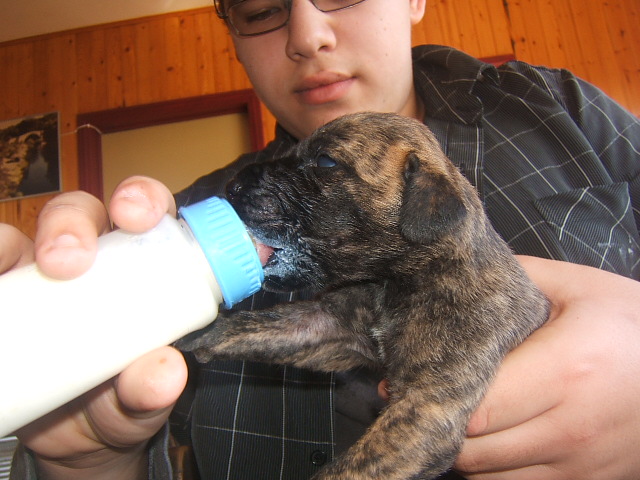
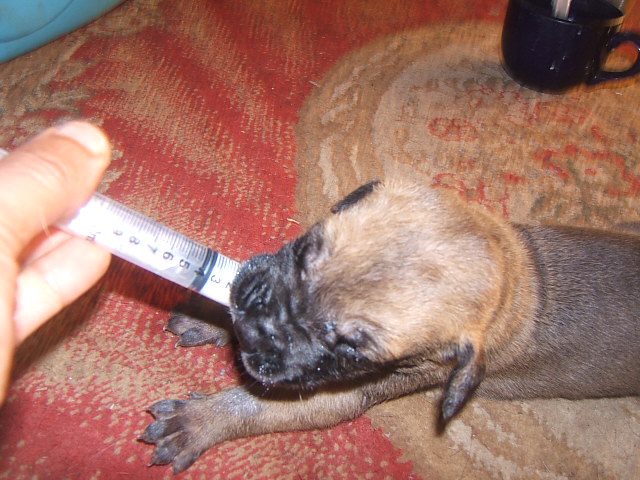
The syringe feeding of pups you see here is in addition to nursing, not a substitute.
bottle feeding with extra
nutrients is in addition to
nursing, not a substitute.
And ... One more very significant advantage our Danes have:
If you are buying a pup from a breeder because you know him or he/she is geographically closer, ask what diet do you administer prior to and during pregnancy? Ask him or her: what are your scholastic qualifications or who is coaching you (a vet or chemist)?
And if the price is low, how could they have provided it when just a modified version would cost about $4 a day X 45 pre-pregnancy, $3X63 days pregnancy & $380 vet = $749 plus $4 a pup X60 days = $240 which in a 6 pups litter means almost $400 a pup cost in this area only!!! (Note that proper feeding of the pup with goat milk and raw beef and pup food is $4 X 60 = additional $240 + $175 vet = $800 cost per pup to age 8 weeks and in just these basic areas only).
This care of the mother pre and during pregnancy is essential to avoid problems a year or two later.
This cost is not accommodated by the average puppy mills and that's why some Danes have severe problems that happens in nature but can be avoided. Obviously a cheap pup could not have had such health care.
And here is a case where neglect can have serious as well as misunderstood consequences.
I am sure this case proves that many other similar cases were misdiagnosed and some Danes died leaving the owner with the belief that the case was more that the real reason.
This video shows a real case of a Dane swallowed a plastic bag and basic diagnosis pointed at first to bloat "gastric torsion" as the reason. It wasn't. Click on this link to watch the video:
And on the subject of health care, here is another video on how neglect can easily influence the dog's health. Chocolate, an example of foods dogs should not have.